


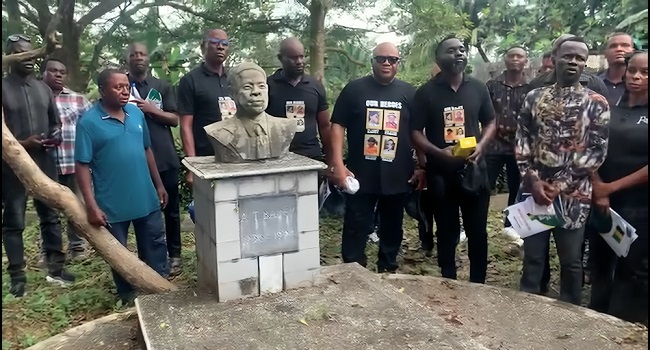
Thirty-one years after the controversial execution of prominent environmental advocate Ken Saro-Wiwa and eight associates, the people of Ogoniland held solemn gatherings to honour their memory and reiterate the enduring call for justice.
However, this year’s commemoration extended beyond the “Ogoni Nine” to specifically focus on the “Ogoni Four”—Edward Kobani, Theophilus Orage, Samuel Orage, and Albert Badey.
Their tragic killing in Gokana Local Government Area immediately preceded the chain of events that led to the 1995 arrest and execution of Saro-Wiwa and his colleagues.
Across Ogoniland, various organisations marked the anniversary with memorial events. In Gokana, the local community, including the Gokana Unity Forum, the Council of Chiefs, and the bereaved families, collectively renewed their urgent demand for the recovery of the bodies of the four men.
These victims were allegedly murdered by an agitated crowd outside the residence of the then Gbemene of Gokana.
The community is adamant that repatriating the remains and affording them a proper, dignified funeral is the essential step needed to achieve genuine closure and lasting peace in the region.
The Gokana Unity Forum voiced its dismay regarding the Movement for the Survival of the Ogoni People (MOSOP), accusing the group of consistently failing to prioritise authentic reconciliation.
The Forum criticised MOSOP for allegedly planning to merely lay wreaths at symbolic gravesites for the Ogoni Four, instead of actively collaborating with key stakeholders to exhume the actual remains, as recommended by the 2001 Oputa Panel.
According to the Forum, the failure to implement these specific recommendations has been the primary obstacle hindering true peace and healing in Ogoniland for decades.
Speaking on behalf of the group, Chris Barigbon declared that the Gokana people have committed to relentlessly pursuing the recovery and proper interment of the Ogoni Four’s remains, emphasising that this action alone represents the true path to lasting justice and tranquillity in the area.
“We state clearly today that the moment has arrived for the remains of Chief Edward Kobani, Chief T.B. Orage, Chief S.N. Orage, and Chief A.T. Badey to be located and repatriated to their loved ones for a respectable burial. This forms the authentic bedrock of peace. Without underlying truth and justice, reconciliation will remain an illusion,” Barigbon asserted.
Goodluck Gbara-Age, the President of the Gokana Unity Forum, pledged that the younger generation will continue the quest for accountability until the full circumstances of the events are genuinely addressed.
This powerful demand for justice was echoed by Kenneth Kobani, a former Minister of State for Industry, Trade and Investment, and a son of one of the murdered men.
In an emotional address, he spoke of the family’s choice of forgiveness, but stressed the critical need for honesty in the reconciliation process to achieve closure.
“It has been 31 years since my father and the others were cruelly killed here in Gokana. We had every justification to seek vengeance, but we chose the path of forgiveness,” Kobani stated.
He underscored that truthful acknowledgement of the past is the mandatory starting point for any meaningful reconciliation.
He condemned what he termed “the persistent denial of clear facts,” alleging that certain factions are attempting to revise history and minimise the intense suffering endured by the victims’ families.
“You cannot erase the past. These men were slain in public, and the perpetrators are known. We have demonstrated sufficient humility and faith in the greater Ogoni cause; now is the moment for those aware of the location of their bodies to reveal it, so we can finally have peace of mind,” he pleaded.
Kobani commended President Bola Tinubu for the recent steps toward reconciliation but urged all parties involved to cease exploiting the Ogoni struggle for political or financial gain.
“Ogoni desires harmony, cohesion, and progress. We have suffered enough; we hold no malice, but we must not be compelled to bury our fathers with empty coffins yet again,” he said.
The gathering, dressed in black and holding signs, also made symbolic visits to the King of Bodo and to the family homes of Badey and Kobani to express solidarity and offer prayers for unity.
In a separate event, the National Youth Council of Ogoni People (NYCOP) organised its own memorial for Ken Saro-Wiwa and his counterparts, hailing them as emblems of bravery and self-sacrifice.
Also see: PHED: The African Landlord and Tenant Relationship
While thanking Tinubu for the pardon issued earlier this year, the youth called for the case to be formally reviewed in court for a full judicial exoneration, alongside the complete implementation of the Ogoni Bill of Rights.
They also spoke out against what they perceive as political exclusion, pointing out that despite Ogoniland comprising four local government areas, no Ogoni person has ever served as Governor or Deputy Governor of Rivers State since the state’s inception.
For the people of Gokana and Ogoniland, November 10 is not merely a date for remembrance, but a renewed and potent campaign for accountability, reconciliation, and representation—a stark reminder that the battle for equality and recognition will persist until every community’s voice is genuinely heard and their specific grievances are addressed.
