


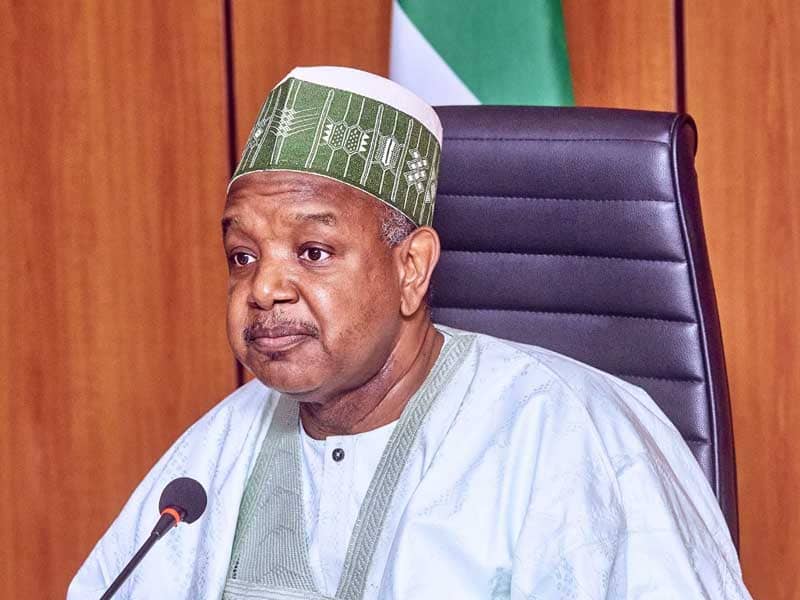
The Minister of Budget and Economic Planning, Abubakar Bagudu, has cautioned that Nigeria must secure at least $100 billion in yearly investments to successfully implement its ambitious Agenda 2050 and prevent economic stagnation.
He delivered this message during a recent policy dialogue in Abuja, emphasising that without a massive influx of public and private capital, the country will fail to meet its long-term development targets.
Speaking at the event, which was organised by the National Institute for Legislative and Democratic Studies (NILDS) and focused on improving collaboration between the legislature and the executive for better economic governance, Bagudu stressed the urgency of the situation.
He warned that Nigeria’s economic competitiveness would continue to decline without significant reforms and stronger governmental cooperation.
Bagudu described Agenda 2050 not as an “idealistic dream,” but as a “realistic pathway” to prosperity.
He explained that the plan aims to transform Nigeria into a middle-income country by 2050, with a per capita GDP of $33,000, powered by substantial investment and sustained productivity.
The minister highlighted Nigeria’s fiscal weakness, noting that the country’s revenue-to-GDP ratio was a meager 9% as of June 2023, far below the global average.
He acknowledged that recent reforms have raised this to 16% but insisted it’s still “punching below our weight.” To illustrate this, he contrasted Nigeria’s annual federal budget of just $36 billion with Brazil’s $700 billion and Japan’s over $20 trillion, budgets he said reflect the reason for divergent national outcomes.
Bagudu affirmed that President Bola Tinubu’s “Renewed Hope Agenda” is a direct response to years of poor fiscal management.
He pointed to the removal of fuel subsidies, foreign exchange market liberalization, and tax reforms as evidence of the administration’s commitment to achieving macroeconomic stability.
Also see: OPM Founder Sends Four Young Men to Saudi Arabia
Looking beyond high-level policy, Bagudu introduced a new ward-based development program designed to identify and formalize economic opportunities at the grassroots level across Nigeria’s 8,809 wards.
This initiative, he explained, aims to empower small businesses and artisans to help lift millions out of poverty.
In his own remarks, NILDS Director-General Prof. Abubakar Sulaiman called for a unified approach from all arms of government to address Nigeria’s fragile economy, which is burdened by high inflation, rising debt, and currency instability.
He stressed the importance of the legislature using its oversight functions to reinforce economic reforms.
The dialogue ended with a general consensus that the nation’s economic future hinges on deep collaboration between institutions and widespread public support for the national development agenda.
Bagudu reiterated his core message: without the discipline to mobilize $100 billion annually, Nigeria cannot achieve its ambitious goals of a $1 trillion economy by 2030 and middle-income status by 2050.
