


There is an increasing acute shortage of healthcare professionals globally: the World Health Organization predicts a shortfall of approximately 4.5 million nurses by 2030. At the same time, nearly one-third of healthcare workers worldwide are already facing burnout, and high turnover rates among staff exacerbate the issue.
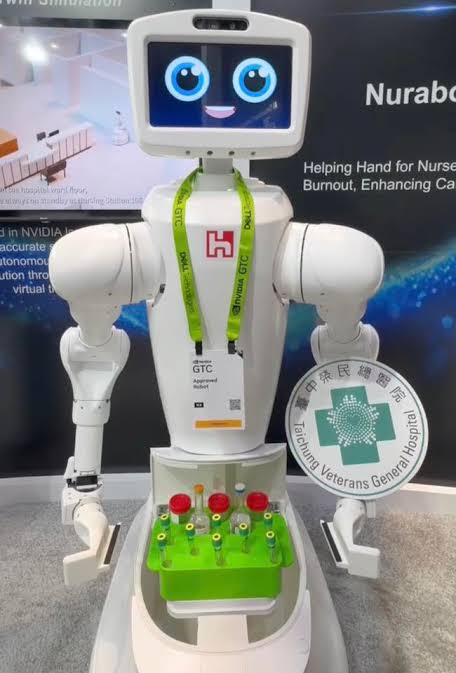
To address these challenges, innovative solutions are emerging – Nurabot, an autonomous AI-driven robot designed to assist with repetitive or physically demanding tasks such as delivering medications and guiding patients through hospital wards. Foxconn claims that this humanoid robot could alleviate nurses’ workloads by around 30%.
”This is not intended to replace nurses, but to work collaboratively in fulfilling our mission,” states Alice Lin, Director of User Experience at Foxconn (Hon Hai Technology Group).
According to the company, Nurabot allows nurses to be relieved of monotonous tasks, enabling them to concentrate on patient care and make clinical decisions grounded in their professional expertise.
Nurabot was developed in partnership with Kawasaki Heavy Industries: its hardware is based on the Nyokkey model, it moves on wheels, features two manipulators for lifting and transferring items, and is equipped with multiple cameras and sensors for spatial awareness.
Additionally, it utilizes Foxconn’s Chinese large language model for communication, while the AI core and robotics framework are developed under NVIDIA’s guidance. This allows the robot to navigate the hospital autonomously, plan its tasks, and respond to both verbal and physical signals.
Also Read: http://LNG Uses AI to Increase Exports and Domestic Gas Supply
In the wider healthcare context, there is an increasing demand for the establishment of “smart hospitals”: an aging population continues to put pressure on health systems. By 2030, a significant rise in the number of individuals aged 60 and older is anticipated, along with an increase in those aged 80 and above.
Experts highlight that AI-enhanced systems can greatly reduce time and costs, aiding in the reengineering of workflows and enhancing efficiency.
Currently, robotic solutions are being implemented in various nations: in Singapore, over 80 robots assist doctors and nurses at Changi General Hospital, while in the United States, around 100 autonomous nurse robots known as Moxi transport medications, samples, and materials between departments.
Nevertheless, research on the effectiveness of nursing robots is still limited: while data indicates a positive perception among staff, the absence of reliable practical data and potential technical issues continue to hinder widespread adoption.
In the industrial sector, investments in healthcare are increasing: companies like NVIDIA, Amazon, and Google are driving market development worth tens of trillions of dollars, and the “smart hospitals” sector is vibrant and rapidly advancing, especially in the Asia-Pacific region.
Nurabot is presently undergoing a pilot program in Taiwan at Taichung Veterans General Hospital. During this testing phase, the robot has restricted access to the hospital’s information system, yet it already demonstrates potential: according to Foxconn, the trial has resulted in a reduction of daily nurse workload by approximately 20–30%. Full integration into standard nursing operations is anticipated by the end of 2025, followed by a commercial launch in 2026.
