


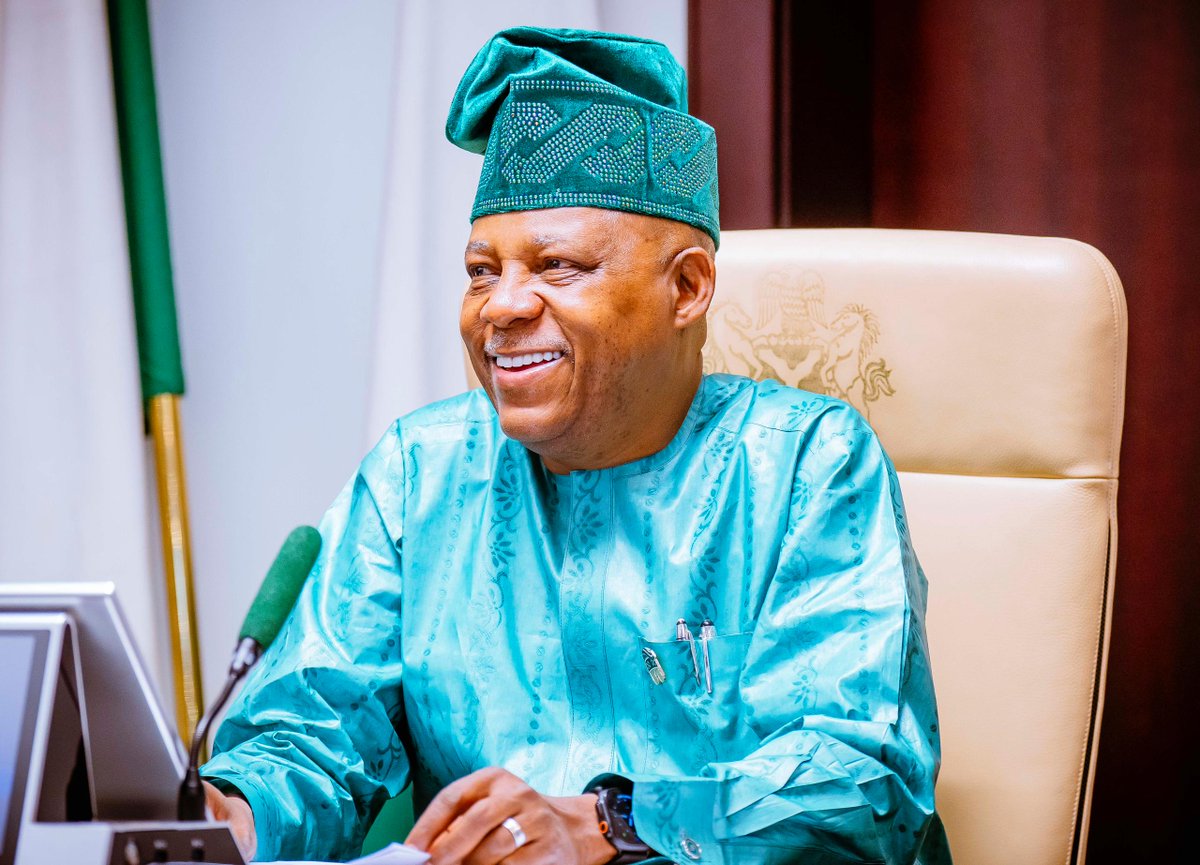
Vice President Kashim Shettima has affirmed that President Bola Tinubu’s administration is dedicated to diversifying Nigeria’s economy, citing the President’s “political courage” as a key factor.
Shettima’s spokesperson, Stanley Nkwocha, in a statement on Friday, said his principal made the remarks at the Presidential Villa while receiving separate delegations from the Nigerian Economic Society (NES) and the Nigerian Institute of Architects (NIA) on Thursday.
During the meeting with the NES, led by its President, Prof. Adeola Adenikinju, Shettima pointed to Tinubu’s recent trip to Brazil, which resulted in five Memoranda of Understanding (MoUs) in aviation, foreign affairs, science and technology, and agriculture, as evidence of the government’s deliberate actions to broaden the country’s economic base beyond oil.
He urged the NES to contribute “robust solutions” to the nation’s challenges, assuring them that the administration is receptive to their input.
Adenikinju commended the administration’s “bold” economic reforms and pledged the society’s full support. The NES also announced plans to confer its highest honour, “Fellow of the Nigerian Economic Society (FNES),” on the Vice President.
In a separate development, the Federal Government (FG) is considering establishing a presidential task team to standardise Nigeria’s architectural framework.
This consideration followed a request by the NIA, whose delegation was led by its President, Arc. Mobolaji Adealo Adeniyi. The NIA also named Vice President Shettima as Nigeria’s “Champion of Good Architecture.”
Also see: FG Reaffirms Commitment to MSME Financing with NCGC Initiative
Shettima assured the architects that all their requests were granted, stressing that the administration recognises the value of their expertise.
He encouraged them to support the government’s efforts, stating that what unites Nigerians “supersedes whatever that divides us.”
The NIA delegation highlighted challenges within the sector, including the use of substandard building materials and a lack of local expertise.
They urged Shettima to champion policies that would elevate design as a national priority and bridge the gap between architectural aspirations and reality.
