


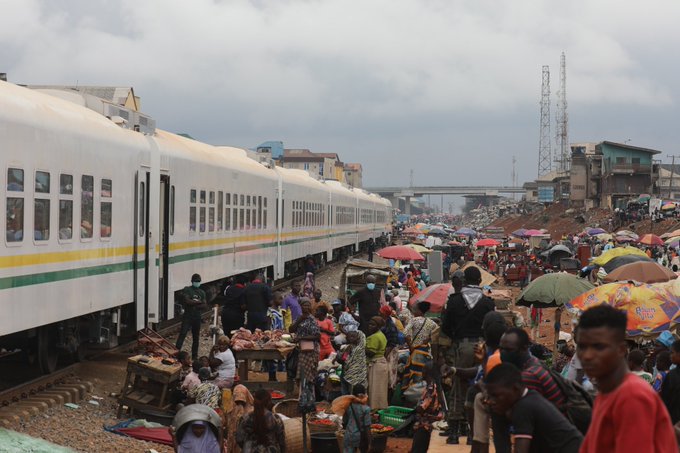
In October 2017 when the President of the World Bank Group, Jim Yong Kim visited Nigeria, he told reporters that President Buhari asked him to focus the bank’s interventions in the country on the North. Buhari has unapologetically continued to showcase primitive ethnic loyalty that guarantees little to no economic value. It was equally made manifest in the recently flagged-off AKK gas pipeline This Northenization of development has been the lens with which the rest of the country sees the Buhari’s administration.
When Nigerians reacted loudly to the last week’s approval by the Federal Executive Council for the Ministry of Transportation to borrow nearly $2 billion for the construction a 284km cross-border Kano – Katsina – Jibia – Maradi rail line, which includes a 93km branch from Kano to Dutse, Aso Rock mounted a defence that was in its usual manner, not convincing. Garba Shehu, the president’s spokesman in a statement said Nigeria was not building a rail line into Niger Republic but only to the designated border point.
Shehu, failing to provide concrete answers to questions over the economic benefits of the rail line, said the objective of the rail is the harnessing of raw materials, mineral resources, and agricultural produce. He added that when completed, “it will serve domestic industries and play the role of a viable transportation backbone to the West African subregion, starting with the neighbouring Niger Republic for their export and import logistic chain”.
Another Media aide to President, Ajuri Ngelale, provided yet another rationalization that was not concrete and said “The rail line will connect 3 states: Kano, Katsina & Jigawa. It moves from Kano to Dambatta, Kazaure, Daura, Mashi, Katsina, terminating in Maradi, Niger Republic. This financially empowers Nigeria as the import/export hub for Niger”.
In essence, Nigeria is abandoning internal economic clusters with huge benefits to build the rail line to make Niger Republic happy at a huge economic cost. This big brotherly role that is always for its neighbour’s benefit has cost Nigeria dearly. RailWorld and The World Bank calculated that it costs $6.5 million per kilometre to build a standard gauge rail track in Ghana and $5.6 million per kilometre of track in Kenya. However, in Nigeria, it costs $9.6 million to build a kilometre of rail track.
The proposed rail line will terminate at Maradi, a town with a population of about 300, 000 that is not up to the population of Onicha in Anambra State or Aba in Abia state; the two most viable economic towns in Eastern Nigeria yet with no connecting rail line. Maradi is also not the main city in Niger but has a huge Fulani population. For the purpose of massaging ethnic ego, Buhari’s administration is ready to borrow to embark on an economic disaster, but that is not how Rotimi Chibuike Amaechi, Nigeria’s Minister of Transportation presented it. In February 2018, Amaechi, while responding to questions over the economic importance of the project, claimed that the project was important because “Niger Republic, Chad and others” had abandoned Nigeria’s seaports. “They go to countries like Benin Republic and they are growing the economy of those people and we do not have deep seaports in Nigeria”, he said.
The port in Cotonou is better managed with a quicker turnaround time than any port in Nigeria and no other person than the minister of transportation should know this. In August 2015, Bolloré Group signed a concession agreement with the governments of Benin and Niger Republics for the construction and operation of a railway from Cotonou in Benin to Niamey in Niger. The project involves rehabilitation of the meter-gauge Cotonou – Parakou line and the construction of a 574 km extension. Niger knew that their best option was through Cotonou and promptly chose the Cotonou-Niamey corridor. Buhari’s government is thinking for a government that is not thinking about itself.
The president’s defenders claim that the rail line is crucial for the transportation of livestock and other agricultural commodities between Maradi and Northern Nigeria but have failed to note that the volume of such livestock and agricultural commodities along that line cannot in any way be compared to the volume of raw materials and finished goods that are moved around Lagos alone; Lagos-Benin; Lagos- Onicha; Lagos to Port Harcourt-Calabar-Aba-Abuja et cetera yet there is no rail line connecting these economic clusters.
The federal government through the minister of transportation has continued to pay lips service to the Lagos-Calabar coastal rail line that is of more economic benefits to the country than any other rail line. In short, it gives much attention to the Lagos-Kano rail line that is of less economic value to the country than the Lagos-Calabar coastal rail line. The reason is obvious; Buhari wants development focused on the North.
World over, rail lines are not built to massage an individual’s ego because of the huge cost associated with it. Rails are built where constructing them make huge economic sense. Niger Republic with a population of 22 million people and a GDP of $9 billion cannot be said to be economically more viable than Lagos with a GDP of above $100 Billion and Rivers with a GDP of $30 billion yet no rail links the states. The Federal government has also failed to work on the all-important Lagos-Calabar rail line that will link Lagos-Warri-Onicha-Aba-Port Harcourt-Calabar together. The contract for the project which was signed by President Goodluck Jonathan with China in November 2014 was for $11.9bn but Amaechi announced in July 2016 that the Buhari’s administration has signed another contract with China for the same coastal rail line, adding that “We were able to save 800 million dollars from the initial sum of the project which will be delivered in the next two years”.
The standard gauge route will link all the cities in Nigeria’s 10 coastal states, from Calabar in the east to Lagos in the west, via Aba, Port Harcourt, Warri and Benin City. Up to date, no one knows the fate of the coastal rail line.
That Nigeria has not been able to connect its economic clusters and many populated cities with rail yet want to waste scarce resources to connect a very arid and sparsely populated city in another country is another testament to the waste and lack of priority that is associated with Buharinomic.
