


I am really trying hard not to be explosive about the ongoing matter. One of the women of God from Taraba State in Nigeria, whom we had the privilege of hosting in our church back in 2018, kept in touch with me for a long time afterwards.
About four or five years ago, she asked me a question that shook me deeply: “What are the churches and pastors in the South doing about the grave plight of Christians in the North?”
She told me that her husband had buried four or five women in that same week—women who had been ambushed on their farms, raped, and murdered by Fulani herdsmen. Members of their congregation had gone to their farms in the morning and never returned home.
Then she said something that haunted me for years: “Our people wake up in the morning to go to work or to church, but we do not know if we will return, or if our bodies will even be found.”
For a long time, I felt that perhaps Nigeria should simply divide, and everyone should go their separate ways. But when I realised the danger that non-Muslims in the North would face if that happened, I abandoned the idea completely.
I often reflect on my pastor friends and acquaintances who opposed me in the years leading up to 2015. They accused me of supporting corruption because I was against the APC. Some even told me that God had shown them in a vision that Buhari would win the election. I asked them a simple question: Did you pray to ask whether that was God’s will for Nigeria, or was He revealing to us what the evil world had already concluded—something we were meant to pray against?
What followed was blood flowing across the nation and a systematic destruction of religious sites bearing the Cross. I still remember a few pastor friends who publicly posted on their social media pages that Buhari would never Islamise the country. But Islamisation is rarely direct—it is gradual, strategic, and often cloaked.
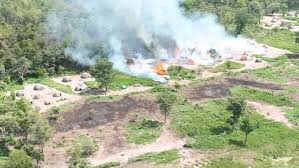
Between 2015 and now, over 200 Christian villages and towns have been completely destroyed across Plateau, Benue, and Bauchi States alone. These once-thriving communities have become dead zones, their indigenous inhabitants denied return by men in military uniforms.
In Borno South, where Chibok is located, the once vibrant Christian communities have been decimated. When we attempted three years ago to sponsor a team to investigate and provide updates, we discovered that journalists were not even permitted entry into Chibok. Why? What exactly are they still covering up?
Take Gwoza, for instance. It once had 178 churches before Buhari’s administration; today, barely 30 remain standing.
And what about the wickedness of El-Rufai in Southern Kaduna—the ruthless land-grabbing and oppression of the indigenous people of that region?
I wish I were not in the bath when the urge to write this came upon me. If I were in my office downstairs, I would have compiled a detailed list of the devastations that Christian communities in the North have endured under the APC governments—atrocities deliberately covered up.
During Jonathan’s administration, there were sporadic church bombings; but under the APC, it became a full-scale invasion. Many indigenous Christian communities may never recover, not for decades to come.
Whenever you hear reports that mosques were also attacked or that Muslims were killed, investigate the background. In almost every case, it is because an imam had preached openly against the Fulani herdsmen or threatened to expose their sponsors. The retaliation comes swiftly.
If a mosque’s imam speaks boldly against Fulani violence or Boko Haram, the financiers behind these groups soon target him. Notably, you will never find such an imam to be a Fulani; he is usually from another tribe. The Fulanis do not preach against themselves.
Ask yourself: how many mosques have been attacked compared to churches? The other imams have learnt the lesson—do not speak against us, or risk your life and your funding. That is the unspoken rule.
Have you ever studied Lebanon?
It was a Christian-dominated country until the 1960s and 70s, when Islamists and Arab fighters under the PLO were allowed into their territory. By 1980, a nation that had once been 67% Christian began to witness the persecution of its Christians. Today, only about 32–35% of Lebanon’s population remains Christian.
Consider Bethlehem. Before the creation of the State of Israel, it was about 82% Christian Arab. By 1967, before the Six-Day War when Israel lost the West Bank to Jordan, it still had around 86% Christian Arabs.
But since Jordan took control after 1967, and later allowed Yasser Arafat’s PLO to establish autonomous rule, the number of Christians in Bethlehem has plummeted to roughly 12% today.
What about the Christian Arabs in Gaza? Or the Black communities in Gaza and the West Bank, who are still forbidden from owning or building their own properties?
Until one understands history, one cannot truly grasp what some people have done in the name of their god. Do not forget—it was Fulani raiders who destroyed the village where Samuel Ajayi Crowther was born, and it was Fulani men who sold him into slavery. They have not changed; they continue to do what they know best.
Unless Tinubu rises from the ashes of insult, seizes control of the government, expels the evil men with Islamist agendas, and enthrones righteousness, his legacy will be worse than that of Rehoboam.
Tinubu must set aside thoughts of 2027 and focus on waging war against these killers who make good Muslims feel ashamed of what others have done in the name of their religion.
If only Tinubu could become the unexpected warrior—take the fight no one believes he has, crush the Islamists, and make Nigeria an unsafe haven for terrorism—the South and the righteous in the North would rally behind him. But if he compromises with those who sponsor these atrocities, his end will be painful.
Why, then, is Nigeria being discussed so intensely on the international stage?
We are the only nation in the world not officially at war yet recording war-level statistics of violent deaths. This should never be.
No African or Western leader has contradicted what Donald Trump said—not China, not Russia, not even Macron of France. And that silence is alarming. When a state becomes earmarked for destruction, the world’s silence becomes deafening.
Also see: Rivers Records 95% HIV Testing Coverage for Pregnant Women — Institute
By now, our ambassadors and diplomats ought to be circling foreign missions, seeking international support for Nigeria’s survival. Yet, I am not even certain if we have active ambassadors or capable diplomats in place.
Ah! My hot bath has turned cold. I will catch a chill soon if I do not get out. How my phone hasn’t fallen into the water is a miracle in itself. Let me dry off and tend to my numb thumb. I suppose this will be my last post on Nigeria—I will return to my usual quietude.
If anything I have written here makes you uncomfortable, please fact-check me. I have evidence, but I will not desecrate my page with the horrific pictures and videos of these demon-possessed men.
In fact, if Southerners were to see certain videos showing these men engaging in vile rituals—acts too shameful to mention—they would never again buy cattle from them. It is all ritualistic. I doubt the Fulanis even eat from their own herds. That too is a fact. Selah.
By Amos Ajewole
