


By Ohaegbu Vanessa
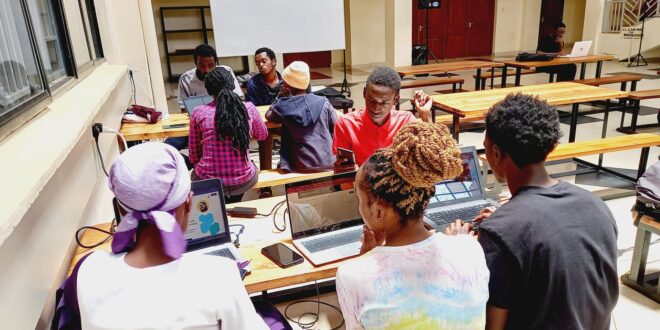
By 8 am, the small restaurant/café on Uniport Road is already buzzing with students, some scrolling through social media, others hunched over laptops. Among them is Amanda, a 300-level mechanical engineering student who looks nothing like an average tech girl. With her headset covering her ear and a plate on her table, she isn’t scrolling through social media like the others; instead, she’s working remotely for a start-up in Canada.
‘’I didn’t plan to work this early’’ she laughs. ‘’But after seeing people losing jobs to AI, I knew I had to get skills that will still matter in ten years’’.
From virtual assistants in Abuja to freelance designers in Lagos, a quiet revolution is happening. Nigerian students are rethinking what ‘’work’’ really means, swapping suits and ties for laptops and Wi-Fi connections. But while some are adapting fast, others still believe a university degree alone guarantees a stable future. As automation creeps into industries like banking, journalism, and even teaching, the big question remains: Are Nigerian Students ready for a world where machines can think, create and complete?.
Across the globe, the workplace is changing faster than ever. Robots can now assemble cars, AI systems can unite articles, and chatbots can handle customer service with zero human supervision. According to the report by the World Economic Forum, nearly 40% of existing jobs could be replaced by automation within the next decade. For centuries, like in Nigeria, where youth unemployment already hovers around 33%, these shifts bring both fear and unemployment.
On one hand, automation threatens traditional careers that generations have relied on. On the other hand, it’s opening doors to digital jobs that don’t require an office, a boss or even a local employer. Remote work and freelance platforms have become the new job market. Students are learning coding, UI/UX design, social media management, data analysis and virtual assistance not just for local companies, but for employers in the U.S., U.K. and Canada.
Also Read: New TUC Chairman Emerges In Rivers State
‘’I earn in dollars, but I work from my hostel room’’ says Olivia, a 21-year-old student from UNILAG who freelances as a graphic designer on Fiverr. ‘’It’s not easy, the data costs are mad, but at least I’m not waiting for NYSC to find me a job’’. Still, not everyone is keeping up. Many universities continue to emphasise old-school courses with little connection to modern realities. In some departments, students still rely on outdated textbooks, while industries demand skills in artificial intelligence, machine learning and automation tools.
For many Nigerian students, the biggest challenge isn’t just learning new skills, it’s the system itself. Most universities still focus on theory rather than practical, job-ready skills. Students graduate knowing definitions but not the digital tools, employers expect them to use.
‘’I was shocked when I got my first internship’’ says Temi, a Computer Science student from UNIBEN. We were taught coding, but when I got to the company, they used completely different software and frameworks. I had to start learning from scratch on YouTube. Lecturers agree that the curriculum hasn’t caught up with the times. Dr Adaobi Nwosu, a career development advisor in Port Harcourt, believes the disconnect is dangerous.
“We’re still teaching students for jobs that existed 20 years ago”, she explains. “Automation isn’t coming; it’s already here. Nigerian graduates need to be creative, tech-savvy and flexible if they want to compete globally.”

One Response
Wow