


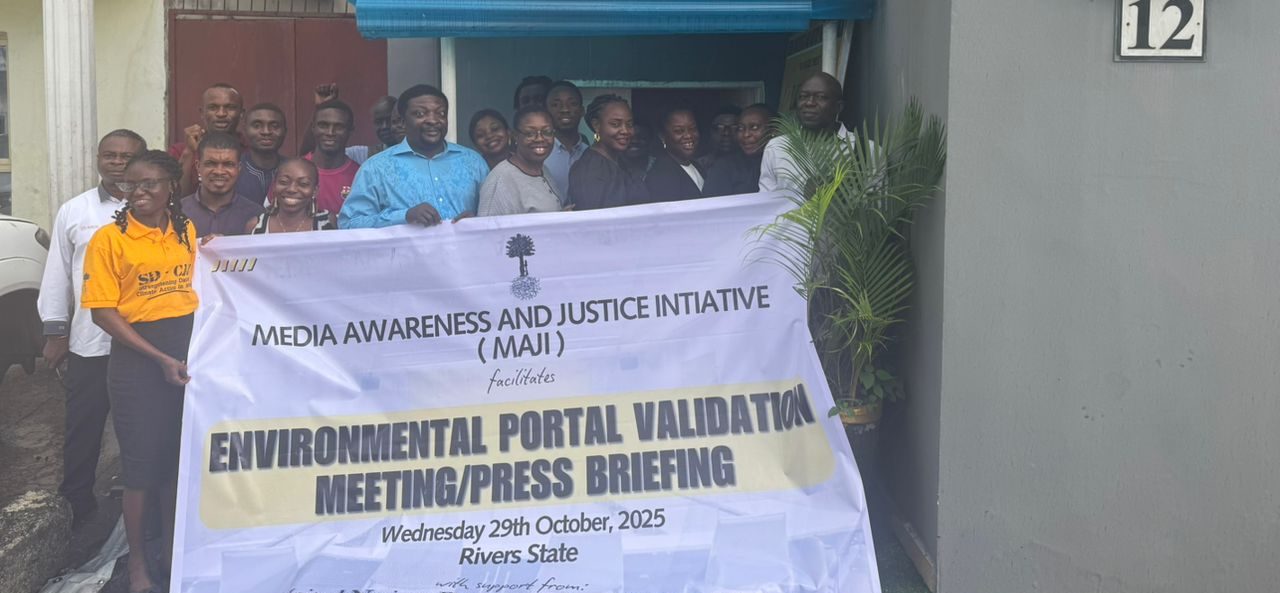
Air quality in several communities across Rivers State has been described as unhealthy and hazardous following findings from a new digital monitoring device known as Data-Cab, designed to measure air pollution levels in local communities.
The Data-Cab device, co-created by Media Awareness and Justice Initiative (MAJI) and Blues Airnotes, with support from is an innovative technology that collects real-time environmental data from last-mile communities with limited digital access.
The initiative leverages technology and human-centered design to promote environmental accountability and social inclusion.
The findings were shared during the Strengthening Data for Climate Action in Nigeria Project and Environmental Portal Validation Meeting, organised by MAJI with support from United Nations Democratic Funds (UDEF) held in Port Harcourt on Tuesday, October 29, 2025.
Speaking at the event, MAJI’s Executive Director, Onyekachi Okoro, said the organization has continued to drive environmental transparency through initiatives such as Connecting the Underserved, Citizen Science, and DataCab. He emphasized that data-driven governance is key to addressing air quality challenges in the Niger Delta.
Also Read: 1,000 Rivers Women Empowered with ₦50,000 Grants by RHI, Rivers Govt
“Our analysis shows that the air we breathe in Rivers State is really unhealthy. This initiative is about empowering communities and government agencies with credible data for environmental accountability,” Okoro said.
Okoro commended the United Nations Democracy Fund (UNDEF) for supporting the project and identified collaboration with key stakeholders including civil society organizations, the media, and government agencies such as NESREA and the Federal Ministry of Environment as crucial in improving air quality monitoring and enforcement.
He disclosed that MAJI is developing a mobile app that will allow residents to access air quality data in real time. The app, he said, would enhance public awareness and support advocacy for cleaner air and climate justice.
Over 20 participants drawn from civil society groups, academia, media, and government agencies were trained during the session on how to use the platform for environmental monitoring.
MAJI reaffirmed its commitment to advancing digital inclusion, strengthening citizen participation in environmental governance, and building community capacity for evidence-based climate action across the Niger Delta.
