


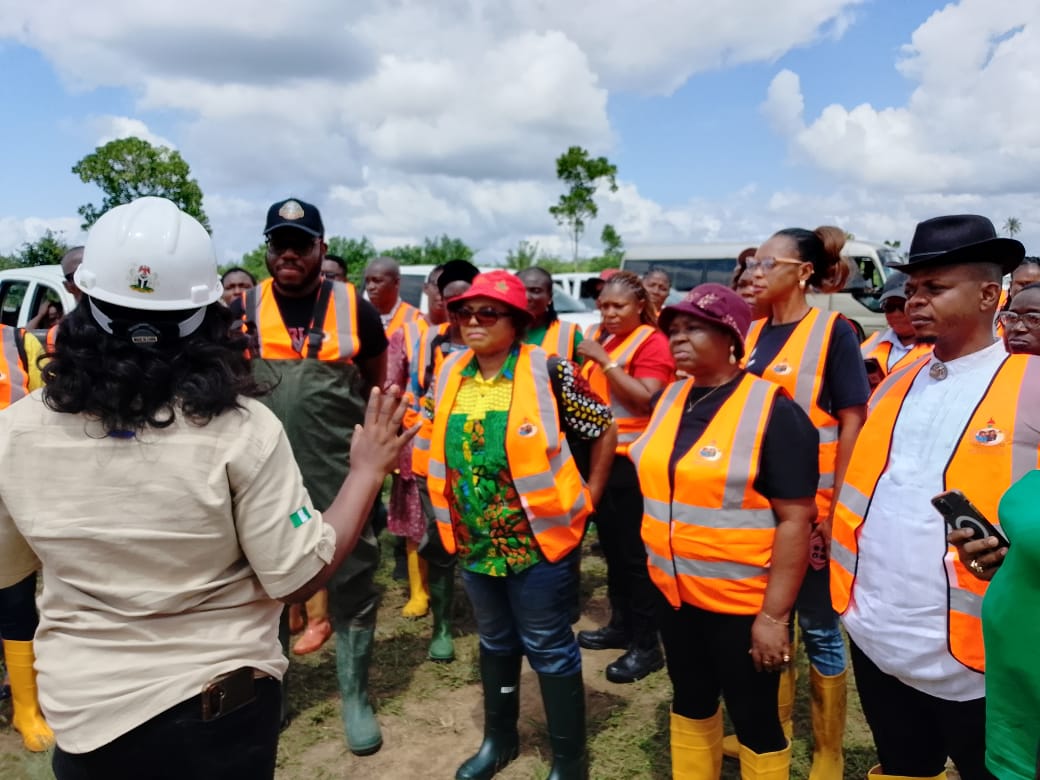
As part of an effort geared towards complementing the Government’s role in reducing the negative impact of Hydrocarbon Pollution, the Kebetkache Women Development and Resource Centre organised a two-day training which was held from Tuesday, September 9 to Wednesday, September 10, on community-based environmental remediation for Women and stakeholders in the Niger Delta Region
Speaking shortly after a controlled visit to a Hydrocarbon Remediation site at Baraliagbo in Tai Local Government Area, the Executive Director of Kebetkache Women Development and Resource Centre, Dr. Emen Okon, said the training was aimed at learning what Remediation is all about in a bid to build the capacity of community women to manage and maintain environmental remediation within the community.
“We have campaigned against the pollution, we have campaigned for ecosystem restoration, and we also know that women have critical roles to play in protecting the environment and promoting environmental sustainability.”
Dr. Okon noted that the training, which was done under the supervision of the National Oil Spill Detection and Response Agency (NOSDRA), was part of gaining knowledge and building the capacity of women on how to contribute to ecosystem restoration positively.
“This is why we had to take this step forward to know what we can do as a community, and we know that this is not enough, but it is a step forward in the right direction.”
One of the participants at the training, Mr Henry Efrebo, an indigene of Obelle in Emohua local government area, appreciated the organisers for the timing of the training, which he noted was a positive step forward towards understanding the role of everyone in cleaning up the environment.
He called for more communities in the Niger Delta to understudy the cleanup process in order for women to be able to actively get involved in the cleanup process, which he noted was important, especially when the Hydrocarbon Pollution is not much.
“If the communities leave the pollution within themselves, the pollution will impact the people. If the pollution is that people can easily take care of it, especially if the pollution is not much, and they could easily till their soil and replicate what we have seen here to restore the environment. If we don’t restore the environment, nobody will do it for us.”
Also Read: Opobo/Nkoro LGA Chairman Flags Off 7.5km Nkoro Internal Road
Another participant of the training, Mrs Gloria Thomas from Ibeno Local Government Area in Akwa Ibom State, explained that every farmer is a potential environmental remediator.
She stated that women farmers are capable of initiating the process of Hydrocarbon Pollution Remediation, especially when such pollution is not much and does not affect groundwater.
“You, as a woman, as long as you are a farmer, you can start the process of remediating your land; you don’t wait for any government agency to come and help you, as long as you are a farmer, you can do it.”
Over fifty trainees were accompanied by NOSDRA officials to visit and observe remediation exercises being carried out on the site.
Excavation was done more than the depth where the pollution occurred in the soil, and soil micro nutrients like NPK fertilisers were introduced into the soil and homogeneously turned with the soil to enable the soil nutrients to mix u,p and aeration was also implemented on the soil.
