


You’re at a fancy restaurant, and the waiter proudly announces that your bill has tripled since last year. But when the food arrives, it’s the same soggy, overcooked mess as before, maybe even worse.
That’s Nigeria’s education system in a nutshell. Over the past five years, the government has nearly tripled its spending on education, ballooning from N602 billion in 2019 to a whopping N1.59 trillion in 2024. Sounds impressive, right? Like we’re finally getting serious about building a brighter future for our kids.
Here’s the punchline: Classrooms are still bursting at the seams like a Black Friday sale gone wrong, kids’ test scores are worse than before, and nearly 20 million children are wandering the streets instead of desks. It’s a national embarrassment that demands we stop patting ourselves on the back for bigger budgets and start asking the real question: Where the heck is all that money going?
Let’s break it down without the jargon, because who has time for that? Back in 2019, Nigeria shelled out about $1.65 billion on education. By 2023, that jumped to $2.73 billion, and $4-ish billion for 2024. President Bola Tinubu even proposed N3.52 trillion for 2025, roughly 6.4% of the total national budget.
On paper, it looks like we’re investing in our kids. But dig a little deeper, and you’ll see the emperor has no clothes. As Tunde Adeoye, a sharp development economist from Lagos, put it: “The budget tells you where a country’s heart is. And Nigeria’s heart is clearly not in education.” Ouch. That’s a wake-up call from someone who crunches these numbers for a living.
Compare us to our neighbors, and it gets even funnier in a dark comedy sort of way. Nigeria hovers around 6-7% of its budget on education, while Egypt throws in 12%, South Africa 9%, and Kenya 8%. In raw dollars, South Africa dropped $28.1 billion in 2023, Egypt $18 billion, and Kenya $6.3 billion—despite Nigeria’s population being way bigger.
We’re the giant of Africa, but our education wallet feels like it’s on a diet. And the kicker? Most of what we do spend vanishes into the black hole of salaries and overheads. Over 65% of the 2024 budget went to personnel costs—paying teachers and staff, which is crucial, sure. But that leaves a measly 30% for the stuff that moves the needle: building new classrooms, stocking labs, training teachers, or even introducing some shiny digital tools to make learning less like watching paint dry.
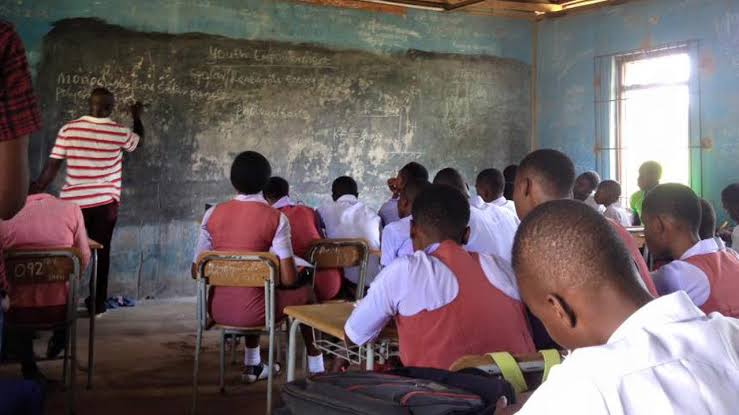
Picture this: A teacher in a rural school, juggling 80 kids in a room meant for 30, with no books, no power, and chalk that’s older than the students. That’s the reality for too many Nigerian kids. Fredrick Major, an education consultant in Port Harcourt, nails it: “Paying teachers is vital, but without investment in facilities, overcrowding, poor materials and absent technology will continue to undermine learning.” He’s spot on. Parents know this all too well. Take Chief Wokoma, a hardworking dad from Rivers State.
He told reporters, “I would like my children to attend public secondary school, but infrastructural gaps and overcrowded classrooms discourage me. So, I have to work and earn money at all costs to send them to private school.” Heartbreaking, isn’t it? If the average parent has to hustle extra just to afford a decent education, what hope is there for the families scraping by on minimum wage?
Now, let’s talk about results or the lack thereof. Despite the cash influx, student performance is flatter than expired soda. UNESCO reports that only 36% of Nigerian primary kids hit basic proficiency in reading and math in 2022 the same dismal rate as in 2019.
Meanwhile, Kenya’s at 57% and South Africa’s at 52%. We’re not even in the game; we’re on the bench, wondering why no one’s passing us the ball. And the out-of-school crisis? UNICEF says 18.5 million Nigerian children were sidelined by late 2024, that’s 15% of the world’s total out-of-school kids. In a country bursting with youthful energy, we’re letting a generation slip through the cracks. It’s like hosting the world’s biggest party but locking half the guests outside.
The trend is even more depressing if you zoom out. In 2015, education snagged 10.75% of the national budget. Fast-forward to 2025, and it’s down to 5.47%. Political speeches about “empowering the youth” ring hollow when the numbers tell a different story. I mean, come on—rhetoric is cheap, but fixing schools costs real money, and we’re skimping where it hurts most.
So, what’s the fix? Throwing more cash at the problem without a plan is like giving a fish a Ferrari, it won’t help it swim. Analysts are screaming for a rethink: Bump capital spending to at least 40% of the budget, focusing on classrooms, teacher training, and tech that could turn dusty blackboards into interactive wonders.
We need regular check-ups too like national tests on literacy, math, and digital skills to track if the money’s making a dent. But here’s the real game-changer: accountability. Education funds have a habit of evaporating into thin air or lining the wrong pockets.
Also see: Satya Nadella Commemorates Microsoft’s Optical Computing Achievement
As one Lagos expert warned, “Without stricter oversight by parliament, civil society and anti-graft agencies, even larger allocations may fail to translate into better outcomes.” Civil society is already on it—the Academic Staff Union of Universities kicked off a 2023 campaign for more funding and autonomy, but fiscal drama and other priorities keep stalling the momentum.
Look, Nigeria’s got a youth bulge that’s either our superpower or our undoing. With the right education, these kids could turbocharge our economy into a knowledge-driven beast. But if we keep this up we’re dooming them to a future of low-skill jobs, if any, and an economy that chugs along on oil fumes while the world races ahead on innovation. It’s not rocket science; it’s basic math. Tinubu’s administration has the chance to rewrite this script. Stop the salary sinkhole, invest in what works, and hold the purse strings tight. Our kids deserve a shot at the stars.
In the end, this paradox is about choices. We’re choosing mediocrity over excellence, short-term patches over long-term wins. Let’s flip the script before it’s too late. Because if we don’t, the real cost is in the dreams we’ll never see fulfilled.
