


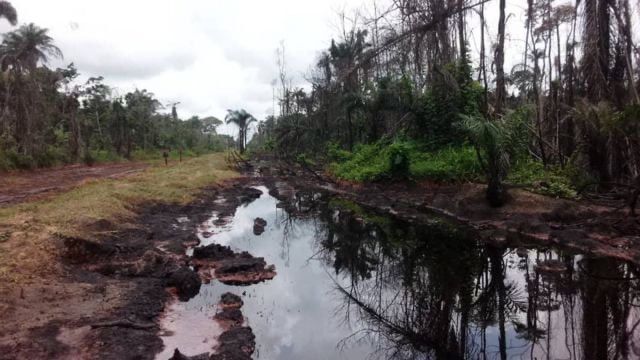
Residents of several Ogoni communities in Rivers State have raised fresh concerns over persistent oil contamination of their waterways and seafood, despite the ongoing remediation work by the Hydrocarbon Pollution Remediation Project (HYPREP).
Fisherfolk from Gbee, K-Dere and Nweemuu voiced their frustrations on Wednesday during a multi-stakeholder dialogue titled “Restoring Rivers, Reviving Livelihoods, Renewing Lives”, held in Kpor, the headquarters of Gokana Local Government Area. The forum brought together affected community members, HYPREP officials, academics from the University of Port Harcourt, civil society groups, NOSDRA representatives, women, youths and other stakeholders.
Community leaders, including Chief Nadabel John, Chief Emmanuel Pii and Madam Grace Namon, said farmlands, vegetation and water bodies remain polluted. According to them, fish and periwinkles harvested from local rivers still emit the smell of crude oil even after cooking, raising fears about food safety and long-term health risks.
The dialogue was convened by investigative journalist Anuoluwapo Adelakun of the Pulitzer Centre for Crisis Reporting, who said the engagement was prompted by investigative findings and repeated complaints from residents, which revealed a communication gap between HYPREP and host communities.
Read more: Khana Schools Launch Students Health Campaign
Adelakun disclosed that independent research conducted in partnership with the University of Port Harcourt found that water sediments in some Ogoni communities still contain dangerous levels of heavy metals, including nickel, a known carcinogen. She added that fish species such as tilapia were also found to have high concentrations of these toxic substances.
“We carried out detailed studies on pollution, remediation and livelihoods, focusing on rivers, wetlands and aquatic life,” she said. “Samples taken from Bodo, K-Dere, Gbee and Mogho show that people are still consuming fish and periwinkles from polluted waters, exposing them—especially children—to serious long-term health risks.”
She noted that while HYPREP reports significant progress in mangrove restoration and shoreline remediation, many families continue to rely daily on contaminated seafood. According to her, the findings indicate a heightened cancer risk for children who consume fish from parts of Ogoniland.
Responding, HYPREP’s Technical Assistant on Shoreline Clean-up, Peter Lenu, disputed claims that periwinkles could survive in heavily polluted environments, describing such assertions as scientifically questionable. He stressed that remediation in Ogoniland is a long-term process expected to last between 25 and 30 years, in line with the United Nations Environment Programme report.
Lenu argued that recent test results showing Total Petroleum Hydrocarbon levels of about 277.5 milligrams per kilogram in one location reflect roughly 98 per cent remediation success, compared to baseline contamination levels exceeding 20,000 milligrams per kilogram.
He explained that HYPREP is using an Enhanced Natural Attenuation approach, which requires time to yield full results, and confirmed that second-phase clean-up contracts have been awarded in five affected communities, with work expected to begin before the end of the first quarter of 2026.
The HYPREP official also suggested that in farming communities like Nweemuu, pollutants could enter rivers through runoff from fertilisers and pesticides. He added that a health impact assessment, being conducted in collaboration with the World Health Organisation, is underway to evaluate the effects of oil pollution on the Ogoni population.
Lenu further highlighted progress in mangrove restoration, noting that over 1.5 million seedlings have been planted across 560 hectares in Bomu, with additional areas to be replanted once certified clean by regulatory authorities.
