


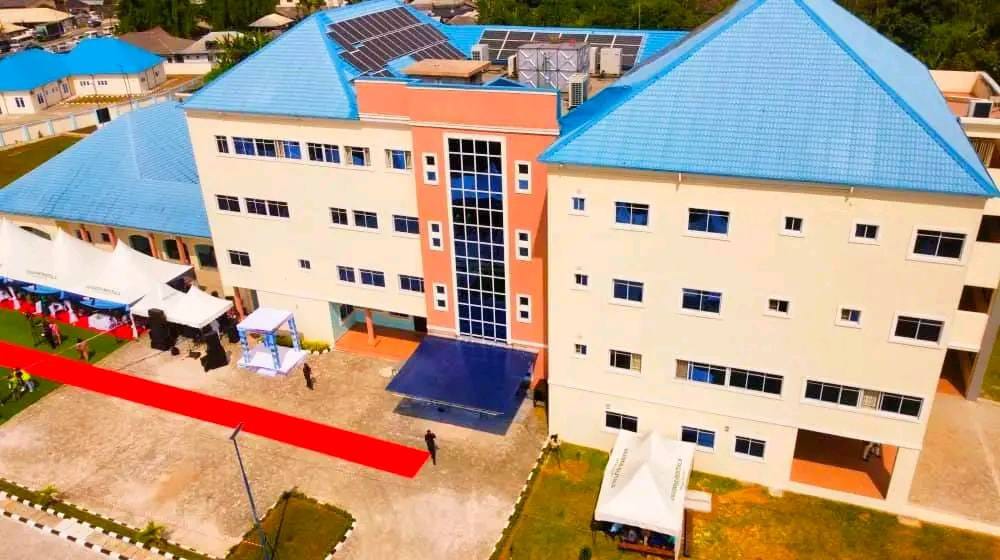
Ahoada,the long-neglected healthcare needs of the Orashi region in Rivers State received a major boost on Tuesday, December 23, 2025, as Governor Siminalayi Fubara commissioned the remodeled and expanded Ahoada Zonal Hospital. The project ends years of abandonment and transforms the facility into a 105-bed ultramodern hospital serving the Rivers West Senatorial District.
The commissioning ceremony in Ahoada Town drew traditional rulers and residents from Ahoada East, Ahoada West, Abua/Odual, and Emohua local government areas. Governor Fubara described the hospital as a “difficult inheritance,” noting that although the project was left in decay by previous administrations, his government prioritized its completion to strengthen secondary healthcare delivery.
According to the governor, the upgraded facility is part of a decentralisation strategy aimed at easing pressure on tertiary institutions such as the University of Port Harcourt Teaching Hospital (UPTH) and the Rivers State University Teaching Hospital (RSUTH). By bringing advanced surgical and diagnostic services closer to rural communities, the administration hopes to improve access and reduce emergency referrals to Port Harcourt.
The hospital now features modern surgical theatres, advanced radiology services, and an intensive care unit (ICU). Rivers State Commissioner for Health, Dr Adaeze Oreh, said the reopening comes at a critical time, citing increased patient turnout and rising maternal healthcare demands across the state. She added that Rivers recently received a $500,000 award for ranking best in primary healthcare delivery in the South-South region for three consecutive years.
Read more: Diri Signed 2026 N1.01 Trillion Budget Bill Into Law
Despite the optimism surrounding the facility, health policy analysts caution that infrastructure alone does not guarantee effective service delivery. Nigeria’s health sector has a history of well-equipped hospitals struggling due to poor maintenance and shortages of skilled personnel. While the inclusion of staff quarters is expected to support round-the-clock services, concerns remain about the continued migration of healthcare professionals and the sustainability of staffing levels.
Analysts also raise questions about the state government’s decision to assume greater control of primary healthcare, traditionally managed by local councils. Governor Fubara has argued that inefficiencies at the local level necessitated the intervention to ensure uniform standards of care. Critics, however, warn that such centralisation could weaken local government autonomy if not carefully managed.
Still, the zonal hospital model—grouping multiple local governments around a central, well-equipped facility—has been widely viewed as practical, provided promised timelines are met. The state government has indicated that similar projects in Degema and Omoku are expected to be completed by March 2026.
For residents of Ahoada East and West, the commissioning represents more than a political achievement. Many say the true test of the project will lie in the hospital’s affordability, staffing consistency, and the reliability of its emergency and intensive care services in the months ahead.
