


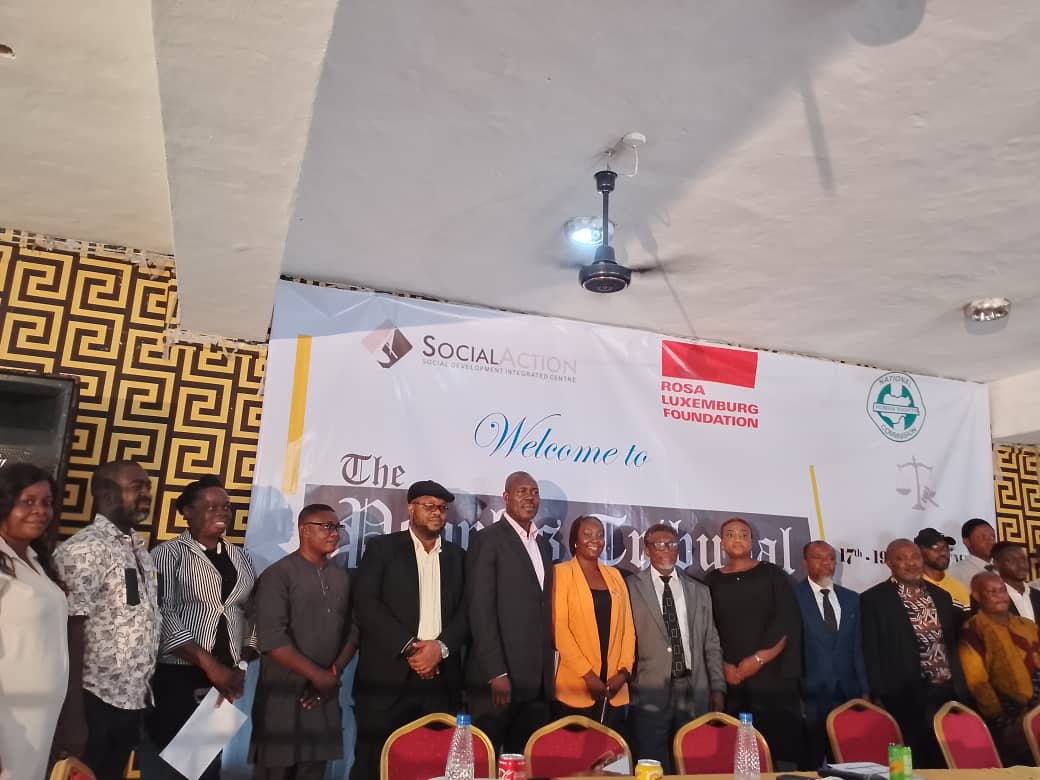
A three-day People’s Tribunal on Human Rights Violations and Environmental Injustice opened in Port Harcourt on Monday, providing a rare public platform for survivors of police brutality, arbitrary detention, and decades of oil-related ecological devastation in the Niger Delta to testify before a panel of eminent jurists, academics, and civil society leaders.
Organised by the Social Development Integrated Centre (Social Action) in collaboration with the Rosa Luxemburg Foundation and the National Human Rights Commission (NHRC), the tribunal seeks to confront Nigeria’s entrenched culture of impunity, particularly in the oil-rich but deeply impoverished Niger Delta region.
Isaac Boti, programme coordinator at Social Action, told the opening session that conventional justice mechanisms have repeatedly failed ordinary Nigerians, leaving grassroots communities without redress for widespread social injustice.
“Victims remain unheard,” he said. “Their pursuit of justice is blocked by institutional inertia, weak law enforcement, and socioeconomic barriers that make access to the courts impossible for the average citizen.”
Although symbolic in nature, the tribunal is intended to produce tangible outcomes. Survivors of security-force abuses and communities ravaged by oil spills, gas flaring, and other forms of environmental degradation are presenting testimony, with the panel expected to issue findings and recommendations.
Mr Boti emphasised that many victims are too poor to navigate Nigeria’s formal legal system.
“Because they cannot prove their cases through conventional means — limited resources, bureaucratic bottlenecks, and cumbersome processes — we have brought the tribunal to the community,” he said.
Emmanuel John, vice-chairman of the Port Harcourt branch of the Nigerian Bar Association (NBA), which is supporting the initiative, said the rule of law cannot exist where justice is absent.
The NBA, he added, is ready to partner with organisations that help the indigent.
“I have seen that most of them have good cases, but the way they go about it is another thing,” Mr John said after the first session.
“From what I gathered today, if they follow the advice given, they can attain justice.”
Also see: Onunu Festival 2025: Where Food, Culture, And Entertainment Meet
Among those testifying was Barineme Lekia from Khana local government area, a victim of marital abuse who told the panel she had suffered mistreatment by her husband because the couple have no children.
She asked the tribunal to intervene, secure compensation, and facilitate dissolution of the marriage.
Representatives from the International Federation of Women Lawyers (FIDA), the National Agency for the Prohibition of Trafficking in Persons (NAPTIP), and the Public Complaints Commission attended, alongside observers from the Nigeria Police Force, the Nigeria Security and Civil Defence Corps, and the Nigerian Army.
The tribunal continues until Wednesday.
